Interactive Voice Response systems are finally catching up with how people actually speak. A generative AI IVR system replaces rigid phone menus with natural, free‑flowing conversations that feel more like talking to a knowledgeable human than pressing buttons on a keypad. According to the TechBullion guide to scaling support, virtual agent assist technologies like these are essential for businesses aiming to grow their support efficiently. By leveraging Bright Pattern AI solutions, companies can deliver faster, friendlier service, scale support without increasing headcount, and gain deeper insights into customer needs.
Beyond simply answering calls, modern IVR systems are starting to integrate with advanced analytics and cloud computing platforms, helping businesses understand customer patterns in real-time. Companies exploring innovative distributed computing networks and collaborative tech infrastructure can combine AI-driven IVR with scalable resources, ensuring conversations remain fast and responsive even during peak hours.
Marketing teams can also benefit from these systems. By connecting IVR insights with customer data, companies can create more personalized campaigns. For instance, platforms like Marketing Runners’ complete guide to improving customer engagement through AI-driven campaigns provide actionable tips for using AI insights to enhance loyalty and messaging across channels. Similarly, long-form guides from Marketing for Customers’ comprehensive strategies for leveraging customer interaction data explain how integrating AI IVR analytics can refine messaging and boost overall retention.
On the tech side, high-performance computing resources remain vital for AI applications. Detailed reviews on supercomputers and advanced AI processing solutions for enterprise systems show how scalable architectures support complex AI IVR workflows, maintaining smooth operation even as call volumes increase. Meanwhile, financial teams can explore top financial resources for businesses investing in AI customer service solutions to understand how adopting these technologies delivers measurable ROI, streamlines operations, and supports long-term strategic planning.
As businesses adopt these innovations, the combination of AI intelligence, flexible conversation design, and real-time analytics creates a support experience that feels remarkably natural. Today’s consumers expect interactions that are quick, helpful, and human-like—something that a modern generative AI IVR system can deliver consistently.
Top 10 Contact Center Solutions for Modern Businesses
When it comes to improving customer interactions, businesses are increasingly turning to AI-powered contact center solutions. A generative AI IVR system helps companies deliver personalized, efficient, and natural conversations over the phone, replacing outdated rigid menus. Here are the top 10 solutions leading the market today.
1. Bright Pattern AI Contact Center Solutions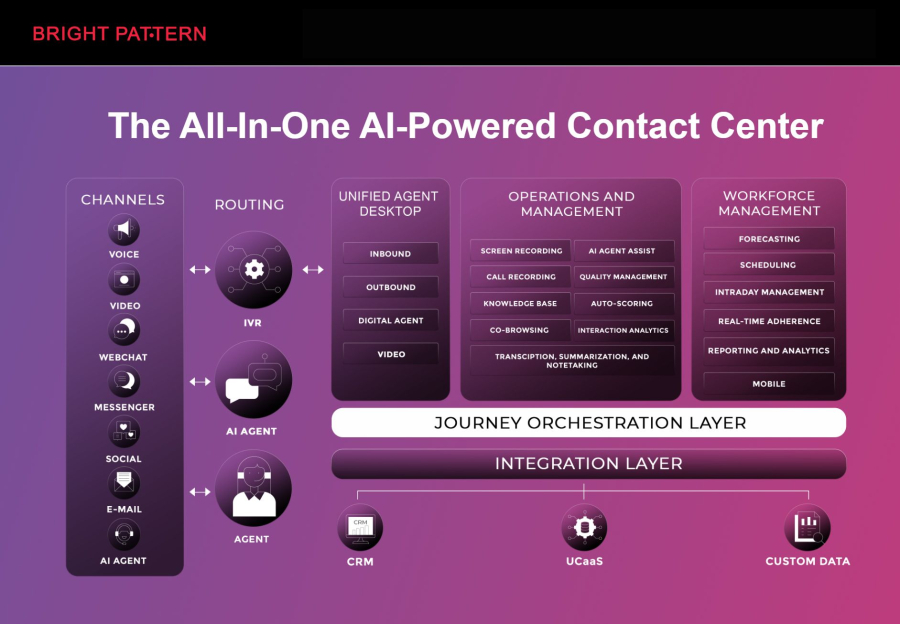
Bright Pattern stands out as a leader in AI-driven contact center technology, offering businesses a comprehensive suite to manage calls, chats, and other customer interactions seamlessly. Its solutions are designed to support omnichannel communication while integrating advanced AI features like natural language understanding, predictive routing, and generative AI IVR system capabilities.
Key features of Bright Pattern include:
- AI-powered conversational IVR for smooth customer interactions
- Omnichannel support including voice, chat, SMS, and email
- Predictive routing to connect customers with the right agent quickly
- Real-time analytics and reporting to improve service performance
- Integration with CRM and business systems for a unified experience
By leveraging Bright Pattern, businesses can scale support efficiently, reduce wait times, and provide customers with human-like conversations, all within a secure, cloud-based platform.

2. Five9 Contact Center Platform
Five9 offers cloud contact center software that enables intelligent routing, AI chatbots, and workforce optimization, helping businesses enhance customer engagement.
3. Genesys Cloud CX
Genesys provides AI-driven customer experience solutions, including omnichannel support, predictive engagement, and AI chat for seamless communication.
4. NICE inContact CXone
NICE inContact delivers a scalable cloud contact center solution with AI-powered routing, analytics, and automation tools to streamline customer service operations.
5. Talkdesk AI Contact Center
Talkdesk combines AI capabilities with cloud infrastructure to provide virtual agents, predictive analytics, and smart call routing for more efficient support.
6. RingCentral Contact Center
RingCentral’s solution integrates voice, video, and messaging with AI-driven analytics and routing to improve contact center performance.
7. 8x8 Contact Center Solutions
8x8 offers cloud-based contact center solutions that leverage AI and analytics for better customer insights, automated workflows, and enhanced agent productivity.
8. Cisco Contact Center AI
Cisco provides intelligent call routing, AI-powered virtual agents, and analytics to optimize contact center operations and customer experiences.
9. Avaya OneCloud
Avaya combines AI and cloud-based communication to deliver omnichannel support, interactive voice response, and advanced workforce management tools.
10. Zendesk Talk
Zendesk Talk integrates call center functionality with AI features, enabling smarter routing, automated responses, and better reporting for customer interactions.
What Is a Generative AI IVR System?
Agenerative AI IVR systemis a voice automation solution that uses advanced language models to understand what callers say in their own words, then generate spoken responses in real time. Instead of forcing customers through fixed option trees, it can handle open questions such as "I need to change my flight" or "Why is my bill higher this month?" and respond conversationally.
In practice, a generative AI IVR typically combines several building blocks:
- Automatic Speech Recognition (ASR)to convert spoken words into text.
- Natural Language Understanding (NLU)to detect intent, extract key details, and interpret context.
- Generative language modelsto craft relevant, natural responses on the fly.
- Text‑to‑Speech (TTS)to deliver those responses back as clear, human‑sounding audio.
- Integrations with back‑end systemssuch as CRMs, billing, booking, or support tools to actually complete tasks, not just answer questions.
The result is an automated voice experience that feels less like a script and more like a smart, always‑on digital employee.
How Generative AI Transforms Traditional IVR
Traditional IVR systems were built around rigid decision trees: "Press 1 for sales, 2 for support." They did their job, but they often frustrated callers, created long journeys, and were expensive to maintain.
Generative AI fundamentally changes this model.
From Menus to Natural Conversations
Instead of navigating a menu, callers can simply say what they need. For example:
- "I want to check the status of my order."
- "I moved to a new address and need to update my account."
- "My internet is down and I already restarted my router."
The system uses AI to interpret each request, ask clarifying questions if needed, and move directly toward resolution. This eliminates many of the dead ends and backtracking that have historically driven IVR complaints.
Dynamic, Context‑Aware Responses
Generative AI IVRs can adapt their responses in real time, based on each caller's situation. They can:
- Recognize returning callers by phone number or account ID.
- Reference recent orders, tickets, or previous interactions.
- Adjust explanations based on what the caller already knows.
- Summarize what has been discussed when handing off to a live agent.
This context awareness makes interactions more efficient and more personal, even when they are fully automated.
Better Self‑Service Completion, Fewer Transfers
Because generative AI is not limited to a small set of hard‑coded flows, it can handle a much wider range of tasks. That means more callers can get what they need without ever speaking to an agent, and those who do reach an agent arrive with their issue pre‑qualified and summarized.
Continuous Improvement Without Heavy Re‑Coding
Traditional IVRs often required extensive development work to change call flows or add new options. Generative AI IVRs can be improved more quickly by updating prompts, guidance, or knowledge bases, and by using analytics to refine how the system responds to common requests.
Key Business Benefits of Generative AI IVR
When implemented thoughtfully, generative AI IVR can deliver measurable gains across service quality, efficiency, and customer sentiment.
1. Higher Customer Satisfaction and Loyalty
- Faster answersbecause callers describe their needs in plain language rather than navigating multiple menu levels.
- More natural conversationsthat feel closer to speaking with an experienced human agent.
- Reduced frustrationfrom misrouted calls, repetitive questioning, and unnecessary transfers.
- Consistent experiences24/7, regardless of time, language, or call volumes.
2. Lower Operating Costs
- Deflection of routine callssuch as balance inquiries, order status, simple updates, and FAQs, freeing agents for higher‑value work.
- Improved first‑contact resolutionso issues are solved in one interaction instead of multiple calls or follow‑ups.
- More efficient staffingsince the virtual agent can absorb peaks in volume without full‑time headcount.
3. Higher Agent Productivity and Engagement
- Pre‑qualified callswhere the AI has already identified intent, gathered information, and captured a call summary.
- Fewer repetitive questionsso agents can focus on complex, relationship‑building interactions.
- Reduced burnoutas agents spend more time on interesting work and less on basic lookups.
4. Rapid Global Scale
- Multilingual supportwith consistent policies and messaging across regions.
- Faster rolloutsof new products, offers, and processes without rewriting countless IVR scripts.
- Easy adaptationto seasonal spikes or special campaigns by reconfiguring AI prompts and intents.
Core Capabilities to Look For in a Generative AI IVR
Not all AI IVR solutions are created equal. When evaluating platforms, focus on capabilities that will directly impact customer experience and operational performance.
Advanced Conversational Intelligence
- Natural language understandingthat can handle accents, interruptions, and free‑form speech.
- Clarification questionswhen the caller's request is ambiguous or incomplete.
- Multi‑turn dialogthat keeps track of context across questions and answers.
- Emotion and sentiment cuesthat can guide when to transfer an upset caller to a human agent.
Intelligent Routing and Deep Integrations
- CRM integrationto identify the caller, view history, and personalize responses.
- Back‑office system accessto execute actions such as changing reservations, updating profiles, or processing simple payments.
- Skills‑based routingto send complex issues to the right agents when human support is needed.
Security, Compliance, and Governance
- Data protection controlsfor recordings, transcripts, and customer identifiers.
- Consent handlingfor recording calls and using data for training and analytics.
- Configurable guardrailsthat keep generative responses on‑brand, factual, and policy compliant.
Analytics, Monitoring, and Continuous Learning
- Call analyticsthat reveal top intents, drop‑off points, and completion rates.
- Quality monitoringof AI responses, including human review workflows.
- Feedback loopsso the system learns from resolved cases and refines its responses over time.
High‑Impact Use Cases for Generative AI IVR
Generative AI IVR is versatile enough to serve many industries. Below are some common examples of where organizations see fast value.
Industry | Example Use Cases |
Banking & Financial Services | Balance inquiries, card activation, payment due dates, lost card triage, simple loan status checks, branch hours, and location information. |
Telecommunications | Outage information, troubleshooting steps, plan changes, data usage inquiries, billing questions, SIM activation, and upgrade eligibility checks. |
Retail & E‑commerce | Order tracking, return and exchange status, product availability, store information, and subscription management. |
Travel & Hospitality | Booking confirmations, flight or reservation changes, baggage questions, loyalty program details, and check‑in guidance. |
Healthcare | Appointment scheduling, reminders, basic pre‑visit screening, insurance verification status, and directions or parking information. |
Utilities & Public Services | Outage reporting, bill explanations, payment arrangements, meter reading submissions, and service move requests. |
A Practical Roadmap for Implementing Generative AI IVR
Successful deployments follow a structured approach. The goal is to launch quickly, prove value, and then expand coverage as you learn more.
- Define your objectives.Clarify what success looks like: reduced average handle time, higher self‑service rates, improved satisfaction scores, or better after‑hours coverage.
- Map your top call drivers.Analyze call recordings and logs to identify the most common intents. Target those that are high volume and relatively low complexity first.
- Design ideal journeys.For each priority intent, map the conversation flow, necessary data, and possible branches. Focus on making each journey short, clear, and outcome oriented.
- Connect to back‑end systems.Ensure the IVR can securely access the data and functions it needs to actually resolve issues, not just answer questions.
- Set conversation guardrails.Configure tone, style, and response boundaries for the generative model, including what it can and cannot say or do.
- Pilot and refine.Launch with a subset of calls, gather feedback from customers and agents, and use analytics to refine prompts, flows, and escalation rules.
- Scale to more use cases.As performance stabilizes, add new intents, languages, and product lines, expanding coverage while maintaining quality.
Best Practices for a Standout Generative AI IVR Experience
To turn your AI IVR into a strategic asset, consider these proven best practices.
- Set expectations from the greeting.Clearly introduce the AI assistant, explain what it can help with, and invite callers to speak naturally. This builds trust and reduces confusion.
- Keep language simple and clear.Use everyday wording instead of technical terms, and break explanations into short, digestible pieces.
- Offer easy access to human agents.Allow callers to reach a person when they ask, and use AI to pass a concise summary so customers do not repeat themselves.
- Continuously test and tune.Review transcripts, monitor key metrics, and periodically update prompts and flows based on real‑world behavior.
- Design for edge cases.Plan how the system will respond when it does not understand, when data is missing, or when a request is outside policy. A graceful handoff can still create a positive impression.
- Align with your brand voice.Configure the AI's tone to reflect your brand personality, whether that is formal, friendly, or highly supportive. Consistency across channels builds trust.
- Include accessibility and inclusivity.Make sure the IVR is usable for callers with different speech patterns, accents, and abilities, and test with diverse groups.
How to Measure Success: Key Metrics for Generative AI IVR
To demonstrate impact and guide continuous improvement, it is crucial to track the right performance indicators.
Metric | What It Shows | Why It Matters |
Self‑Service Containment Rate | Percentage of calls fully resolved by the AI without agent transfer. | Direct indicator of automation effectiveness and cost savings. |
First‑Contact Resolution | Share of issues solved in a single interaction. | Strongly correlated with satisfaction and loyalty. |
Average Handle Time (AHT) | Time from call start to resolution, including AI and human segments. | Shorter, more focused calls reduce queues and operational costs. |
Customer Satisfaction (CSAT) | Customer rating of the interaction, often via post‑call surveys. | Captures how callers feel about the AI experience. |
Net Promoter Score (NPS) | Likelihood of recommending the company after recent contact. | Shows long‑term impact of improved service on brand perception. |
Call Abandonment Rate | Percentage of callers who hang up before resolution. | Helps detect friction points, long waits, or confusing flows. |
Escalation Rate to Agents | How often calls move from AI to a human. | Guides where to expand AI capabilities or refine journeys. |
The Future of IVR Is Generative and Customer‑First
Generative AI IVR systems are redefining what is possible in automated customer service. They move organizations beyond static menus and scripted responses to flexible, intelligent conversations that work for both businesses and their customers.
By combining natural language capabilities, deep system integrations, and robust governance, companies can create IVR experiences that are faster, more personal, and consistently on brand. The payoff is compelling: higher satisfaction, lower costs, more engaged agents, and a modern service experience that supports long‑term growth.
Organizations that invest in generative AI IVR today are not just upgrading their phone systems; they are laying the foundation for a unified, conversational customer journey across voice and digital channels. As models improve and new capabilities emerge, these systems will only become more powerful, giving early adopters a lasting advantage in how they serve and retain their customers.
